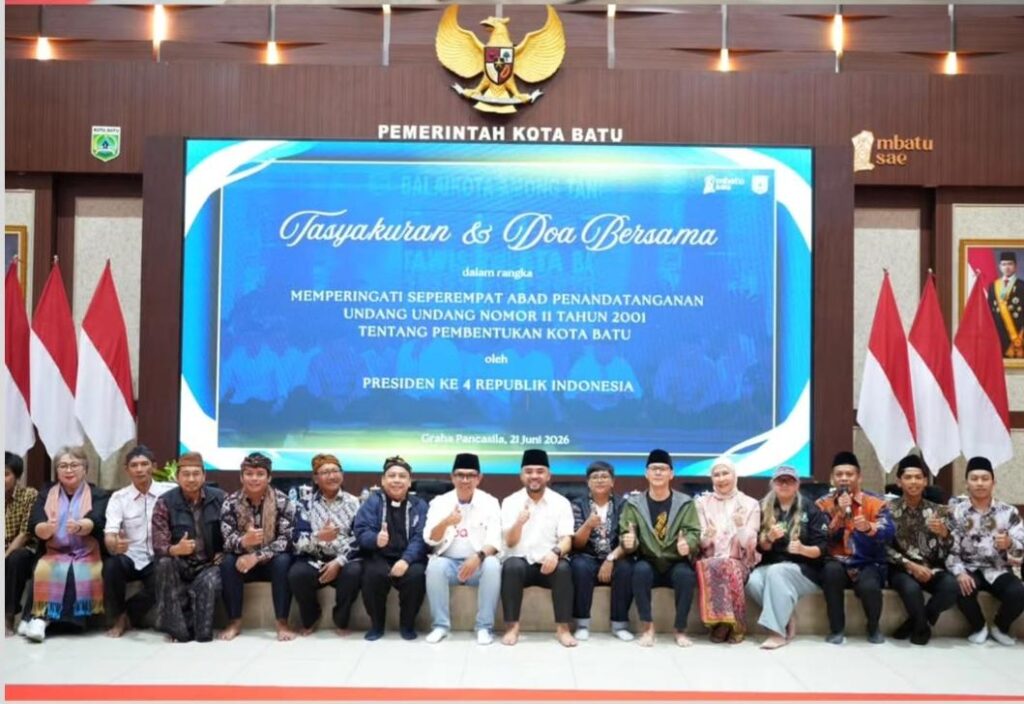
MALANG POST – Pemerintah Kota Batu menggelar tasyakuran dan doa bersama lintas agama di Graha Pancasila, Balai Kota Among Tani, kemarin malam, untuk memperingati 25 tahun penandatanganan UU Nomor 11 Tahun 2001 tentang Pembentukan Kota Batu. Momentum seperempat abad berdirinya kota otonom ini, dihadiri langsung oleh Wali Kota Nurochman dan Wakil Wali Kota Heli Suyanto, sebagai ruang refleksi sejarah sekaligus penegasan komitmen pembangunan ekologis yang berpihak pada petani lokal.
Seperempat abad itu waktu yang panjang. Bagi sebuah daerah otonom, usia 25 tahun adalah fase kedewasaan.
Waktu berlalu begitu cepat sejak Kota Batu lahir melalui Undang-Undang Nomor 11 Tahun 2001. Kemarin malam, di Graha Pancasila Balai Kota Among Tani, pemerintah daerah menggelar tasyakuran dan doa bersama. Suasananya khidmat. Hangat. Tapi yang paling penting: ada ruang refleksi yang mendalam di sana.
How Bettingguideau Explains V8 Supercars Betting Odds to Australian Fans
Australian motorsport has long held a special place in the national sporting consciousness, and V8 Supercars — now officially branded as the Supercars Championship — sits at the heart of that passion. With events like the Bathurst 1000 drawing crowds exceeding 200,000 over race weekend and television audiences in the millions, the series generates substantial wagering activity throughout each season. Yet for many fans who want to engage with betting markets, the odds formats, market structures, and underlying calculations can feel opaque. This is where platforms dedicated to explaining motorsport wagering in plain language have become genuinely useful. Bettingguideau has emerged as one of the more methodical resources helping Australian fans decode the mechanics behind V8 Supercars betting markets, offering explanations that go beyond surface-level summaries to address how odds are actually constructed and what they mean in practical terms.
Understanding How V8 Supercars Odds Are Structured
The first thing any punter needs to understand about V8 Supercars betting is that the odds reflect probability estimates set by bookmakers, adjusted for a margin that ensures the operator’s profitability regardless of outcome. In Australian markets, odds are almost universally presented in decimal format — a legacy of the country’s regulated wagering environment and the influence of the Totalisator Agency Board system that shaped local betting culture for decades. A decimal odd of 6.00 on a driver means the bookmaker is implying a roughly 16.7 percent chance of that driver winning, though the actual payout on a one-dollar stake would be six dollars, including the return of the original stake.
What makes V8 Supercars markets more complex than, say, a two-horse race is the field size. A typical Supercars Championship round might feature 24 or more cars, meaning the sum of all implied probabilities — before the bookmaker’s margin is applied — would theoretically equal 100 percent. In practice, the overround, which is the bookmaker’s built-in margin, pushes that sum to somewhere between 108 and 120 percent in most motorsport markets. This means that if you simply added up the implied probabilities from every driver’s odds, you’d arrive at a figure well above 100, representing the bookmaker’s edge. Bettingguideau explains this concept clearly, showing fans how to strip the margin out of displayed odds to understand what the market is actually saying about each driver’s chances.
The series itself has undergone significant structural changes that affect how odds are set. The shift from the traditional V8 engine configuration to the Gen3 regulations introduced in 2023 — which brought in Chevrolet Camaro and Ford Mustang body styles with 5.4-litre engines — altered the competitive landscape considerably. Early Gen3 rounds saw unexpected parity shifts, with teams that had dominated under the previous Supercar regulations suddenly finding themselves recalibrating setups. Bookmakers had to adjust their modelling accordingly, and the odds in the opening rounds of 2023 were notably wider than usual, reflecting genuine uncertainty about which manufacturers and teams had adapted most effectively.
Beyond outright race winner markets, V8 Supercars betting includes top-ten finish markets, head-to-head matchups between specific drivers, fastest lap propositions, and championship futures. Each of these markets carries its own overround and its own set of variables. A head-to-head market, for example, typically carries a lower overround than an outright field market because there are only two outcomes, making it easier for sharp punters to identify value — and for bookmakers to price tightly. Understanding which market type suits a given level of knowledge is one of the more practical skills any motorsport bettor can develop.
How Track Characteristics and Race Format Influence the Odds
One of the most instructive aspects of V8 Supercars betting analysis involves understanding how specific circuits and race formats affect the probability distribution across the field. The Supercars Championship visits a diverse range of venues — from the permanent road courses at Sydney Motorsport Park and Phillip Island to the street circuits at Adelaide, Newcastle, and Townsville, and the iconic Mount Panorama circuit at Bathurst. Each venue has a distinct character that systematically advantages certain car and driver combinations.
Mount Panorama is the clearest example. The Bathurst 1000, held annually in October, is a 1000-kilometre endurance race requiring two drivers per car and placing enormous demands on fuel strategy, tyre management, and mechanical reliability over roughly six hours of racing. Because of the endurance format, the probability of any single car winning is genuinely lower than at a sprint round, not only because of the larger field but because mechanical attrition plays a significant role. Historically, the Bathurst 1000 has seen the outright favourite win far less frequently than sprint race favourites in comparable fields — a statistical reality that experienced punters factor into their assessment of odds. The favourite at Bathurst has historically won at a rate well below what the implied probability of their odds would suggest, which is a meaningful inefficiency if you understand it correctly.
Street circuits introduce a different set of variables. At events like the Repco Supercars Championship rounds in Newcastle or Townsville, the lack of run-off areas means that a single mistake by any driver can trigger a safety car period that reshuffles the entire competitive order. Bookmakers account for this by widening their margins on outright markets at street circuits, reflecting the higher variance. Punters who understand this dynamic can make more informed decisions about whether the odds on offer adequately compensate for the uncertainty involved.
Qualifying performance is another critical variable that the odds don’t always reflect in real time. In sprint format rounds, where races are typically 250 kilometres or fewer, starting position is highly correlated with finishing position — particularly at circuits with limited overtaking opportunities. When a dominant championship contender qualifies poorly due to a technical issue or a red flag interruption, the market sometimes adjusts slowly, leaving a brief window where the odds on a recovery drive don’t fully account for the driver’s pace advantage. Those who follow qualifying closely and understand the circuit’s overtaking characteristics are better positioned to assess whether a post-qualifying odds movement is justified or an overreaction.
For fans wanting a detailed breakdown of how these race-specific factors are incorporated into market pricing, resources that walk through the methodology step by step are invaluable — you can read more about these analytical frameworks on dedicated motorsport wagering platforms that cover the Supercars calendar in depth.
Championship Futures Markets and Long-Term Wagering Considerations
Championship futures markets — bets placed on which driver will win the Supercars Championship outright at the end of the season — operate on a different logic than individual race markets. These bets are typically placed before the season begins or during the early rounds, and they require punters to think about probability over a 14-round, 26-race season rather than a single event. The mathematics of championship betting are worth understanding in detail.
In a season where a dominant driver wins eight of the 26 races and finishes in the top five in most others, the championship points system — which awards 300 points for a race win down to 34 points for tenth place, with additional points for qualifying and fastest lap — tends to reward consistency over outright pace. This means that a driver who wins four races and finishes second in twelve more can realistically challenge a driver who wins eight races but has three retirements. Bookmakers model this through the season, adjusting championship odds after each round based on the cumulative points standings and the remaining opportunities for points to change hands.
The points system also means that the championship can effectively be decided well before the final round if one driver builds a sufficiently large lead. In 2022, Shane van Gisbergen’s championship lead was effectively insurmountable before the final event, which meant that futures bets placed on him early in the season had already settled in practical terms even before the official conclusion. Punters who had taken van Gisbergen at pre-season odds of around 2.50 to 3.00 — reflecting his status as defending champion but also the competitive threat from rivals including Brodie Kostecki and Chaz Mostert — would have seen strong returns on a bet that was essentially resolved by round twelve.
Bettingguideau addresses the question of when to place championship futures bets in some depth, explaining how the value proposition changes at different points in the season. Pre-season odds tend to be the widest in terms of the bookmaker’s margin, because uncertainty is highest. Mid-season odds, particularly after a dominant stretch by one driver, often compress dramatically — sometimes to the point where the implied probability significantly overstates the leader’s chances given the remaining variance in the calendar. Late-season odds, once a driver is mathematically close to the title, often offer very little value on either side.
There is also the question of how team dynamics affect championship markets. Supercars is a manufacturer-backed series, with Chevrolet and Ford both providing factory support to their respective teams. Within manufacturer teams, there are sometimes implicit or explicit team orders that affect how resources are allocated between teammates. A team with two championship contenders may at some point prioritise one driver’s title campaign, effectively reducing the other’s realistic chances. This is not always reflected quickly in the betting markets, particularly when both drivers are close on points and the team’s preference is not publicly stated.
Understanding the relationship between a driver’s points deficit and the number of remaining races is one of the more practical skills in championship futures betting. With 300 points available for a race win and the points gap closing or widening based on relative finishing positions, a 500-point deficit with six races remaining is a very different proposition than the same deficit with twelve races remaining. The mathematics of maximum possible points accumulation sets a hard ceiling on what’s achievable, and any bet placed without understanding that ceiling is essentially uninformed.
Practical Approaches to Reading and Comparing V8 Supercars Markets
One of the most actionable skills a V8 Supercars bettor can develop is the ability to compare odds across multiple bookmakers and identify when a particular market is mispriced relative to the broader consensus. In Australia, the regulated wagering market includes a significant number of licensed operators — including Sportsbet, TAB, Ladbrokes, Neds, PointsBet, and several others — each of which sets their own odds independently. Because their pricing models differ and their exposure to liability on specific outcomes varies, the odds on a given driver can differ meaningfully between operators at any given moment.
A driver priced at 4.50 with one operator and 5.50 with another represents a 22 percent difference in implied probability — a gap that is far too large to be explained by rounding alone and suggests that one operator has a materially different view of the driver’s chances, or has taken significant liability on that driver from other customers and adjusted accordingly. Identifying these discrepancies and understanding why they exist is the foundation of line shopping, which is the practice of placing a bet with the operator offering the most favourable odds on a given outcome.
The timing of odds movements is also instructive. In the 24 to 48 hours before a race, markets typically tighten as more information becomes available — practice session lap times, weather forecasts, any mechanical issues identified in pre-race checks, and the weight of money from sharp bettors who have done detailed analysis. A driver whose odds shorten significantly in this window without any obvious public reason may be the beneficiary of informed money, which is a signal worth noting even if the reasons aren’t immediately apparent.
Conversely, a driver whose odds drift outward in the final hours before a race — particularly if they had been considered a strong contender — may be the subject of negative information that hasn’t been publicly confirmed. Teams sometimes manage information carefully to avoid giving competitors advance notice of mechanical problems, but the betting markets often reflect that information before it becomes public knowledge. This is a well-documented phenomenon in horse racing and increasingly observed in motorsport markets as well.
Weather is another variable that the casual fan often underestimates. V8 Supercars tyres — currently supplied by Dunlop under the series’ control tyre regulations — behave very differently in wet conditions than in the dry. Some drivers have historically demonstrated a significant wet-weather advantage, and when rain is forecast for a race day, the odds on those drivers can offer genuine value if the market hasn’t fully adjusted. The 2021 Supercars season included several rain-affected rounds where the odds on wet-weather specialists were not adequately revised before race start, creating opportunities for punters who had done their research.
Bettingguideau’s approach to explaining these dynamics is notable for its emphasis on the underlying logic rather than specific tips or predictions. The platform focuses on teaching fans how to read markets rather than telling them what to bet on — a distinction that matters because the most durable edge in any betting market comes from understanding the mechanics well enough to make independent assessments, not from following someone else’s selections without knowing the reasoning behind them.
V8 Supercars betting is a genuinely complex domain that rewards careful study of both the sport itself and the mechanics of wagering markets. The intersection of technical regulations, circuit characteristics, team dynamics, points mathematics, and bookmaker pricing creates a rich environment for fans who want to engage with the series at a deeper level. Understanding how odds are constructed, how they move, and what those movements signal about the information available in the market is the foundation on which any serious approach to motorsport betting must be built. For Australian fans who follow the Supercars Championship closely, developing this understanding transforms the viewing experience as much as it informs any wagering decisions — because the same analytical skills that help you read a betting market also help you understand why races unfold the way they do.
Kota wisata yang kita nikmati kemajuannya hari ini tidak lahir dari proses instan. Bukan jatuh dari langit. Ada cucuran keringat, pengorbanan besar, dan doa malam yang panjang dari para pendahulu.
Aura sejarah itu terasa kental karena deretan tokoh penting hadir duduk melingkar. Ada Wali Kota Batu Nurochman, Wakil Wali Kota Heli Suyanto, jajaran Forkopimda, hingga kepala desa, lurah, dan perwakilan lintas agama.
Yang istimewa, Wali Kota Batu periode 2017–2022, Dewanti Rumpoko, juga tampak hadir. Dan yang paling dihormati malam itu: jajaran Kelompok Kerja (Pokja) Peningkatan Status Kota Batu. Merekalah para bidan sejarah yang dulu bertarung memperjuangkan pemekaran kota ini agar lepas dari Kabupaten Malang.

TASYAKURAN: Pemkot Batu bersama Pokja peningkatan status Kota Batu saat tasyakuran seperempat abad penandatanganan UU No 11 tahun 2021 tentang pembentukan Kota Batu. (Foto: Ananto Wibowo/Malang Post)
Wali Kota Batu yang akrab disapa Cak Nur naik ke podium. Dia tahu diri. Dia memberikan penghormatan setinggi-tingginya kepada para sesepuh Pokja.
Cak Nur secara terbuka menyampaikan kalimat kulon nuwun—mohon izin kepada para pendiri untuk melanjutkan roda pemerintahan. Dia berjanji nilai perjuangan, keberanian mengambil keputusan besar, dan semangat kebersamaan masa lalu tidak boleh berhenti menjadi dongeng pengantar tidur di buku sejarah. Ruh itu harus tetap hidup dalam setiap kebijakan pembangunan.
“Terima kasih kepada seluruh Pokja dan para pendiri yang telah meletakkan fondasi. Kami mohon izin untuk melanjutkan roda pemerintahan,” ujar Cak Nur.
Namun, di tengah kepulan aroma kebahagiaan 25 tahun, ada peringatan serius yang ditiupkan. Peringatan yang sangat penting bagi masa depan Batu.
Pesan itu datang dari anggota Pokja pendiri kota, Dr. Slamet Hendro Kusumo. Kalimatnya tajam. Menusuk ke jantung realitas Kota Batu hari ini.
Hendro mengingatkan dengan keras agar arah pembangunan Kota Batu jangan sampai tersesat. Jangan sampai silau oleh gemerlap investasi fisik dan pertumbuhan ekonomi, lalu tega melupakan identitas aslinya. Jati diri Batu itu adalah kawasan pertanian. Batu adalah daerah resapan air. Batu adalah penyangga ekologis bagi Malang Raya.
“Jangan sampai pembangunan mengorbankan kawasan pertanian dan daerah resapan air. Itu adalah kekuatan utama Kota Batu,” tegas Hendro.
Sentilan Hendro itu logis. Jika semua bukit dikepung beton dan aspal, pariwisata Batu justru sedang menggali kuburnya sendiri. Keseimbangan alam harus dirawat.
Acara malam itu ditutup dengan indah. Diawali dengan pemberian santunan kepada anak-anak yatim. Sisi kemanusiaan yang wajib ada. Kemudian dilanjutkan dengan doa bersama lintas agama. Tokoh-tokoh dari berbagai keyakinan bergantian merapal doa keselamatan. Indah sekali. Prosesi lalu diakhiri dengan pemotongan tumpeng sebagai simbol rasa syukur komunal.
Memasuki usia 25 tahun, tantangan Kota Batu sudah bergeser total. Bukan lagi soal bagaimana cara berdiri dan diakui sebagai daerah otonom. Tantangan hakikinya adalah bagaimana memastikan pembangunan tetap berjalan berkelanjutan, lingkungan tidak rusak, dan bumi Batu tetap bersahabat untuk diwariskan kepada anak cucu kelak. (Ananto Wibowo / Ra Indrata)