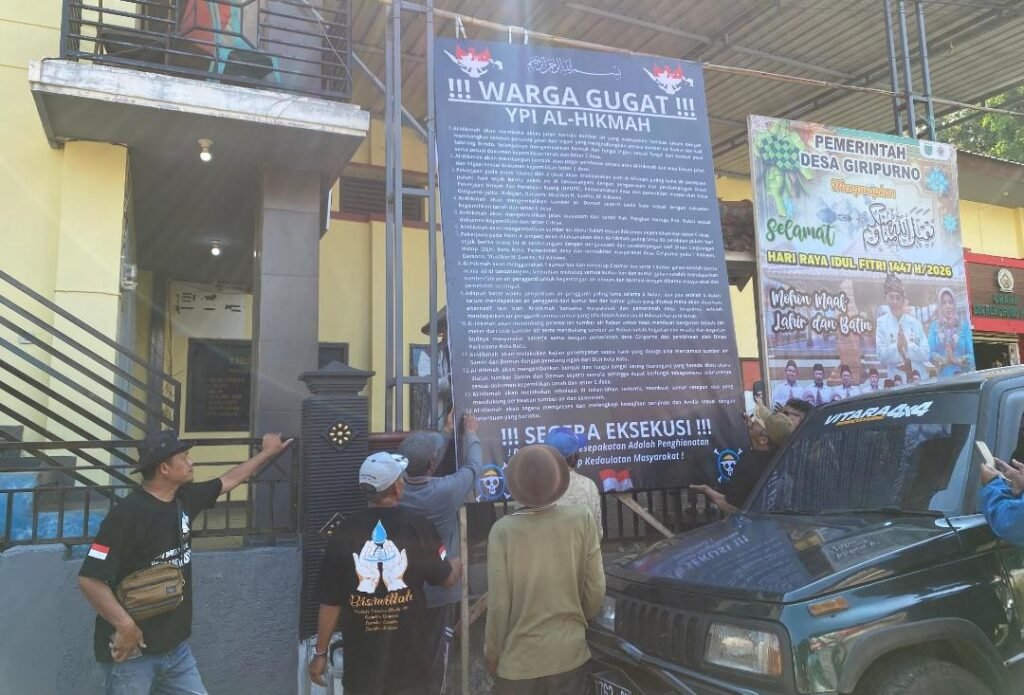
PASANG SPANDUK: Perwakilan warga Giripurno saat memasang spanduk gugatan kesepakatan yang telah disetujui antara warga dan YPI Al Hikmah, namun kesepakatan tersebut dinilai tidak diralisasikan salah satunya soal ABT. (Foto: Ananto Wibowo/Malang Post)
MALANG POST – Tata kelola izin Air Bawah Tanah (ABT) di Kota Batu memicu konflik sosial yang menempatkan pemerintah daerah dan desa sebagai korban salah sasaran dari kemarahan publik. Pakar Vulkanologi UB, Prof Sukir Maryanto, pada Senin (22/6/2026) mengungkapkan bahwa rentetan aksi protes warga di Desa Giripurno dan proyek greenhouse strawberry Desa Sumberbrantas merupakan dampak langsung dari penarikan wewenang perizinan (SIPA) ke pemerintah pusat dan provinsi, yang menyisakan beban sosial dan lingkungan di tingkat akar rumput.
Ini adalah cerita tentang betapa kacaunya pembagian kekuasaan di negeri kita. Urusan air bawah tanah (ABT) di Kota Batu kini jadi contoh paling telanjang: pusat yang punya kuasa, daerah yang kebagian sengsara.
Why Low Deposit Casinos Are Growing in New Zealand According to 5DollarDepositCasinos
New Zealand’s online gambling market has undergone a quiet but significant transformation over the past several years. While the country’s regulatory framework has historically been restrictive — the Gambling Act 2003 remains the foundational legislation, and it does not explicitly license offshore online casinos — New Zealand residents have continued to access international platforms in large numbers. Within this landscape, one particular segment has expanded with notable speed: low deposit casinos, especially those accepting minimum deposits of five dollars or less. The growth of this category is not accidental. It reflects a convergence of economic pressures, shifting consumer expectations, technological changes in payment processing, and the way that information about these platforms has become far more accessible to ordinary players. Understanding why this niche has grown so rapidly requires looking at each of these forces in turn.
The Economic and Demographic Context Driving Demand
New Zealand has experienced meaningful cost-of-living increases since approximately 2021, with the Reserve Bank of New Zealand reporting that inflation reached a three-decade peak of 7.3 percent in mid-2022 before gradually easing through 2023 and into 2024. For discretionary spending categories like online entertainment and gambling, this kind of inflationary pressure tends to produce a bifurcation in consumer behavior: high spenders consolidate their activity on a smaller number of platforms, while more casual participants look for ways to stretch their entertainment budgets further. Low deposit casinos serve the second group directly. A five-dollar deposit allows a player to participate in real-money gaming without committing to a threshold that would feel financially meaningful during a period of tighter household budgets.
The demographic profile of New Zealand’s online gambling audience also matters here. Research published by the New Zealand Gambling Commission and related bodies has consistently shown that younger adults — those in the 18 to 34 age bracket — represent a disproportionately large share of online casino users. This cohort is also more likely to be renting, carrying student debt, or working in part-time and gig-economy arrangements. For these players, the psychological and practical barriers associated with higher minimum deposits are genuine. A platform requiring a fifty-dollar or even twenty-dollar minimum to access real-money games creates friction that a five-dollar threshold does not. The willingness to engage with a new casino goes up substantially when the financial commitment required to test the platform is low enough to feel inconsequential if the experience turns out to be disappointing.
This is not purely a New Zealand phenomenon. Similar trends have been documented in Australia, Canada, and across Scandinavian markets, all of which share comparable regulatory ambiguities around offshore online gambling and similar demographic profiles among online casino users. What makes New Zealand somewhat distinctive is the relatively small size of the market — the country’s population of approximately five million means that word-of-mouth and community-level information sharing play an outsized role in shaping which platforms gain traction. When a low deposit casino earns a positive reputation among a cluster of players, that reputation spreads quickly through social networks, online forums, and dedicated review communities.
How Information Aggregators Have Accelerated Market Growth
One of the most important structural changes in the New Zealand online casino market over the past decade has been the emergence of specialized information platforms that focus specifically on low deposit options. Prior to roughly 2015, a player looking for casinos with low minimum deposits would need to visit each platform individually, read through terms and conditions, and often create an account before discovering that the deposit threshold was higher than expected or that the welcome bonus had conditions that made it impractical. This friction discouraged experimentation and kept many casual players anchored to a small number of well-known platforms regardless of whether those platforms actually suited their preferences.
Dedicated aggregator and review sites changed this dynamic substantially. By cataloguing casinos specifically by their minimum deposit requirements, these platforms made it possible for a player to identify suitable options in minutes rather than hours. The information available at http://5-dollar-deposit-casinos.com/, for example, reflects how granular this kind of resource has become — covering not just deposit thresholds but also the payment methods accepted at each threshold, the bonus structures available to low-deposit players, and the software providers whose games appear on these platforms. This level of detail was simply not available to the average New Zealand player five or six years ago, and its availability has directly contributed to the growth of the low deposit segment by reducing the information asymmetry that previously existed between casinos and players.
The aggregator model also creates accountability pressure on casinos. When a platform’s deposit conditions, bonus terms, or withdrawal policies are publicly documented and compared against competitors, the platforms that offer genuinely player-friendly terms gain visibility while those with misleading structures are more easily identified and avoided. This has encouraged a degree of competitive improvement in the low deposit segment specifically. Casinos that want to appear favorably in reviews and comparison tables have an incentive to make their terms clearer and their minimum deposit offerings more genuinely accessible. Sites like 5DollarDepositCasinos have played a measurable role in shaping these competitive dynamics within the New Zealand market.
Search behavior data further illustrates the growth of interest in this category. Google Trends data for New Zealand shows sustained increases in search volume for terms related to low deposit and minimum deposit casinos between 2019 and 2024. The peak periods correlate with both economic stress events — the COVID-19 lockdowns of 2020 and 2021, and the inflation peak of 2022 — and with broader increases in online gambling participation that were documented globally during periods of restricted physical movement. The combination of more people looking for online entertainment and more of those people being financially cautious created near-ideal conditions for low deposit casino platforms to grow their New Zealand user bases.
Payment Technology and the Five-Dollar Threshold
The specific prominence of five-dollar minimums — as opposed to ten-dollar or twenty-dollar thresholds — is partly a function of payment processing economics. For much of the early history of online gambling, processing a very small deposit was genuinely costly relative to the value of the transaction. Credit card networks and early e-wallet providers charged flat fees or percentage-based fees that made sub-ten-dollar transactions economically unattractive for casinos. A casino accepting a five-dollar deposit through a Visa or Mastercard transaction in 2010 would often pay more in processing fees than the deposit itself generated in expected revenue from that player’s session.
The expansion of alternative payment methods has substantially changed this calculation. E-wallets like Skrill and Neteller reduced per-transaction costs significantly, and the emergence of cryptocurrency payment options — Bitcoin, Ethereum, and more recently stablecoins like USDT — has pushed processing costs lower still for platforms that accept them. Neobank services and prepaid card options have also proliferated in New Zealand, giving players more ways to fund online accounts without incurring the fees that traditional credit card transactions carry. As the cost of processing small transactions has fallen, the economic case for casinos to offer five-dollar minimums has strengthened correspondingly.
New Zealand’s banking environment has added a specific local dimension to this dynamic. Several major New Zealand banks implemented restrictions on credit card transactions to offshore gambling sites in the early 2020s, following similar moves by Australian banks. ANZ, ASB, and BNZ all introduced varying degrees of restriction or blocking on gambling-related transactions, which pushed players toward alternative payment methods. This shift had the indirect effect of accelerating adoption of e-wallets and cryptocurrency among New Zealand online casino users — and these are precisely the payment methods that make low minimum deposits most feasible. Players who had already set up Skrill or Neteller accounts to work around banking restrictions found that these same accounts allowed them to deposit as little as five dollars on platforms that supported them.
The technical infrastructure of casino platforms themselves has also improved in ways that support low deposit models. Modern casino software can handle micro-transactions efficiently, and the growth of mobile-first gaming has created an audience that is accustomed to small, frequent transactions from app store purchases and in-game spending. The psychological familiarity with spending small amounts on digital entertainment — a pattern established by mobile gaming — translates directly to comfort with five-dollar casino deposits. Players who have spent years making one-dollar and two-dollar in-app purchases on mobile games do not experience a five-dollar casino deposit as a significant financial event, which reduces the hesitation that might otherwise prevent first-time deposits.
Regulatory Ambiguity and Its Role in Market Structure
New Zealand’s regulatory environment for online gambling deserves careful attention because it shapes the market in ways that are not immediately obvious. The Gambling Act 2003 established the legal framework that governs gambling in New Zealand, and under this framework, the only legal online casino is the state-operated New Zealand TAB for sports betting and Lotto New Zealand for lottery products. There is no licensing regime for private online casinos operating within New Zealand. However, the Act does not explicitly criminalize the act of playing at offshore online casinos, meaning that New Zealand residents can access international platforms without facing legal consequences as players.
This creates a market structure that is unusual by international standards. New Zealand players are not operating in a fully regulated domestic market with consumer protections enforced by a local authority, nor are they in a market where online gambling is explicitly prohibited. They exist in a gray zone where the platforms they use are licensed in other jurisdictions — Malta, Gibraltar, Curaçao, and the Isle of Man are the most common — but not subject to direct oversight by New Zealand regulators. The Department of Internal Affairs, which administers the Gambling Act, has historically focused its enforcement efforts on operators rather than individual players, and no New Zealand resident has faced prosecution for playing at an offshore online casino.
This regulatory ambiguity has had a specific effect on the low deposit segment. Because New Zealand players cannot rely on domestic regulatory bodies to vet the casinos they use, they have become more dependent on independent review platforms and community knowledge to assess which casinos are trustworthy. Resources like 5DollarDepositCasinos serve a quasi-regulatory function in this environment by providing comparative information that helps players identify platforms with solid licensing credentials, fair bonus terms, and reliable withdrawal processes. The absence of a domestic licensing regime has, paradoxically, created stronger demand for independent information sources — and this demand has in turn supported the growth of the aggregator platforms that make low deposit casinos more visible and accessible.
There have been periodic discussions within New Zealand’s political and regulatory community about reforming the Gambling Act to address online gambling more directly. A Department of Internal Affairs review in 2021 examined options for a domestic licensing regime, but no legislative changes had been enacted as of 2024. If a licensing regime were introduced, it would likely impose minimum standards around responsible gambling tools, payment processing transparency, and bonus term clarity — standards that could further legitimize the low deposit segment by ensuring that the platforms offering five-dollar minimums meet consistent baseline requirements. Until such reform occurs, the market will continue to be shaped primarily by competitive dynamics and the information ecosystems that players use to navigate it.
The growth of low deposit casinos in New Zealand is ultimately a story about alignment — between economic conditions that make players cautious about discretionary spending, technological developments that make small transactions economically viable for both players and operators, information infrastructure that makes it easier to find and evaluate suitable platforms, and a regulatory environment that leaves the market open to international competition. Each of these factors would be significant on its own, but their simultaneous presence over the past five to seven years has produced a particularly favorable environment for the five-dollar deposit category to expand. As long as these underlying conditions persist — and there is little reason to expect any of them to reverse dramatically in the near term — the segment is likely to continue growing as a share of New Zealand’s online gambling market.
Mari kita bedah logikanya. Jika ada pengusaha mau menyedot air tanah di Batu, ke mana mereka harus mengurus Surat Izin Pengusahaan Air Tanah (SIPA)?
Jawabannya: bukan ke Balai Kota Among Tani. Bukan pula ke kantor kepala desa setempat. Mereka harus terbang ke Jakarta, ke Kementerian ESDM. Atau paling dekat ke Dinas ESDM Provinsi Jawa Timur di Surabaya. Daerah tidak punya kuasa. Bahkan sekadar mengeluarkan rekomendasi teknis pun, Pemkot Batu sudah mandul.
Tapi, apa yang terjadi ketika air disedot habis-habisan? Sumber air warga surut. Sumur mongering. Lingkungan rusak.
Siapa yang pertama kali digedor dan didemo oleh warga? Ya kepala desa. Ya walikota. Merekalah garda paling depan yang harus menadah caci maki dan tekanan publik.
Fenomena aneh ini bukan fiksi. Ini riil terjadi di Kota Batu. Tengok saja dua kasus yang belakangan bikin gaduh. Pertama, polemik pemanfaatan air di lembaga Al-Hikmah, Desa Giripurno. Kedua, proyek greenhouse strawberry di Desa Sumberbrantas, Kecamatan Bumiaji.

Guru Besar bidang Ilmu Vulkanologi dan Geothermal UB, Prof Sukir Maryanto. (Foto: Istimewa)
Warga yang marah langsung mendatangi balai desa dan pemda. Mereka menuntut keadilan. Padahal, pemda sendiri sebenarnya sedang melongo. Tidak tahu-menahu kapan izin itu terbit dari atas.
Guru Besar bidang Ilmu Vulkanologi dan Geothermal Universitas Brawijaya, Prof Sukir Maryanto, geleng-geleng kepala melihat kondisi ini. Menurut Sukir, ini adalah akibat dari evolusi regulasi yang berjalan mundur selama belasan tahun terakhir.
Dulu, aturan mainnya enak. Lewat PP Nomor 43 Tahun 2008 tentang Air Tanah, pemerintah kabupaten dan kota masih diberi taji. Mereka punya ruang kewenangan untuk mengatur halaman rumahnya sendiri.
Lalu, badai sentralisasi datang. Lahir UU Nomor 37 Tahun 2014 tentang Konservasi Tanah dan Air. Aturan ditarik ke atas. Diperketat lagi lewat PP Nomor 22 Tahun 2021.
Sejak itu, kewenangan bupati dan walikota dipreteli. Struktur urusan sumber daya alam dibuat berlapis-lapis dan membingungkan masyarakat. Urusannya harus lewat Dirjen Minerba hingga Badan Geologi di Jakarta. Memang, ada delegasi ke provinsi, tapi daerah tetap saja jadi penonton.
“Sebenarnya bukan hanya air. Pertambangan, kehutanan, dan yang berkaitan dengan sumber daya alam itu kewenangannya banyak di pusat,” kata Sukir.
Di sinilah letak ketidakadilannya. Akuntabilitas publik dan beban moral tetap menempel erat di jidat pemerintah daerah.
Saat warga protes karena debit airnya susut, pemda tidak bisa berbuat banyak. Kuasa mereka dikunci. Pemda hanya diberi sisa tugas untuk mengurusi tata ruang (RTRW), AMDAL, UKL-UPL, serta menjinakkan konflik sosial jika warga sudah mulai mengamuk.
Ini situasi yang sangat ironis. Pemda memikul beban sosial dan politik yang berat, tapi tidak punya pulpen untuk membatalkan izin yang merusak itu.
Bagi Sukir, sengkarut ini tidak bisa diselesaikan secara sepihak. Harus ada duduk bersama lintas kementerian dan lembaga. Evaluasi total.
Sebagai akademisi, Sukir pasrah. Kampus hanya bisa menyodorkan kajian ilmiah dan tumpukan rekomendasi. Eksekusinya ada di tangan penguasa. “Kadang suara akademisi didengar, kadang juga tidak,” keluhnya jujur.
Satu hal yang pasti, ada konflik kepentingan yang pekat di sini. Ketika eksploitasi ekonomi skala besar dipaksakan bertemu dengan kebutuhan dasar hajat hidup orang banyak, air harusnya menang. Sesuai UU Sumber Daya Air, kepentingan masyarakat lokal wajib ditaruh di urutan nomor satu.
“Daerah jangan hanya kena mudaratnya. Harus ada benefit yang kembali ke daerah, dalam bentuk apa pun,” tegas Sukir.
Keseimbangan antara mengeruk keuntungan bumi, mitigasi bencana, dan regenerasi alam sudah di ambang batas bahaya. Jika ketimpangan kewenangan pusat-daerah ini terus dirawat, suara protes dari lereng Gunung Arjuna dipastikan tidak akan pernah reda.
Ini adalah alarm keras bagi Jakarta untuk segera mengembalikan hak air kepada pemilik aslinya: rakyat di daerah. (Ananto Wibowo/Ra Indrata)
Baca Juga:
![Minta Dindikbud Tak Cari Legitimasi: Komisi D DPRD Kota Malang Minta Anggaran Rp300 Juta Dialihkan k...]()
Minta Dindikbud Tak Cari Legitimasi: Komisi D DPRD Kota Malang Minta Anggaran Rp300 Juta Dialihkan k...
![Perhutani Gelar Monev dan Percepatan Kerjasama Kemitraan MDH di KPH Malang]()
Perhutani Gelar Monev dan Percepatan Kerjasama Kemitraan MDH di KPH Malang
![Asep Kusdinar: Potensi Desa dan Ketahanan Pangan Kunci Pembangunan Jatim]()
Asep Kusdinar: Potensi Desa dan Ketahanan Pangan Kunci Pembangunan Jatim
![TNI-Polri dan Dishub Kawal Salat Istisqa Bersama Bupati Malang di Pagak]()
TNI-Polri dan Dishub Kawal Salat Istisqa Bersama Bupati Malang di Pagak