
Dekan FE UIN Maliki Malang, Misbahul Munir, para ketua dan sekretaris prodi, mendengarkan sesama paparan kurikulum OBE dari narasumber dalam workshop, Selasa (23/6/2026). (Foto: Eka Nurcahyo/Malang Post)
MALANG POST – Fakultas Ekonomi Universitas Islam Negeri (FE UI) Maulana Malik Ibrahim (Maliki) Malang berkomitmen terus meningkatkan kompetensi lulusan lewat evaluasi kurikulum. Terbaru, lewat kurikulum berbasis Outcome Based Education (OBE).
Karena itu FE UIN Maliki Malang menggelar workshop kurikulum OBE, Selasa (23/6/2026). Dua narasumber yang kompeten di kurikulum ini dihadirkan ke FE UIN. Yaitu, Prof. DR. Mahirun, S.E., M.Si (Dekan Fakultas Ekonomi dan Bisnis Universitas Pekalongan) dan Dr. Wenti Ayu Sunarjo, S.Kom, MM, (Ketua Program Studi Manajemen Universitas Pekalongan). Acara di Meeting Room FE UIN Malang ini juga diikuti dengan penandatanganan Perjanjian Kerja Sama (PKS).
Dekan Fakultas Ekonomi UIN Malang, Dr. H. Misbahul Munir, Lc., M.EI, menyampaikan rasa penasarannya yang mendalam terhadap 2 narasumber ini awalnya.Karena berdasarkan informasi 2 orang inilah yang kompeten di bidangnya yakni Outcome Based Education (OBE) yang sekarang menjadi bahan assesmen lapangan.
Betzoid Investigates the Mechanics of Football Prediction Systems
Football prediction has evolved from a casual pastime into a sophisticated discipline that blends statistical modeling, behavioral science, and data engineering. Millions of fans and analysts attempt to forecast match outcomes every week, yet the underlying mechanics of how these predictions are built, validated, and applied remain poorly understood by most. Whether the goal is recreational engagement, fantasy league dominance, or informed decision-making in sports markets, understanding what drives predictive accuracy in football is both intellectually rewarding and practically valuable. This article examines the core frameworks that power modern football prediction systems, tracing their historical development and exploring the analytical methods that separate reliable models from guesswork.
The Historical Evolution of Football Prediction Models
The earliest attempts to predict football outcomes relied almost entirely on intuition and basic form analysis. Journalists and fans would assess a team’s recent results, home advantage, and head-to-head records before arriving at a verdict. While these factors remain relevant today, they represent only a fraction of the variables that modern systems incorporate. The transformation began in earnest during the 1990s when statistical researchers started applying probability theory to football data in academic contexts.
One of the foundational contributions came from statisticians Maher (1982) and later Dixon and Coles (1997), who developed mathematical models using Poisson distributions to estimate the likelihood of different scorelines. The Poisson model works on the assumption that goals scored by each team follow an independent random process, governed by an attack strength and a defense weakness parameter. Dixon and Coles refined this approach by introducing a correction factor for low-scoring matches, particularly 0-0 and 1-0 results, which the basic Poisson model tended to underestimate. These academic foundations laid the groundwork for the commercial and consumer-facing prediction tools that emerged in the following decade.
By the mid-2000s, the proliferation of digital sports data created new opportunities. Companies began collecting granular in-game statistics — shots on target, possession percentages, expected goals, pressing intensity — and feeding them into increasingly complex models. The expected goals (xG) metric, which assigns a probability value to each shot based on its location, angle, and game context, became one of the most influential developments in football analytics. Rather than simply counting goals, xG allowed analysts to evaluate the quality of chances created, offering a more stable and predictive measure of team performance than raw scorelines.
Core Methodologies Behind Modern Prediction Systems
Contemporary football prediction systems draw from several distinct methodological traditions, often combining them into hybrid frameworks. The three dominant approaches are statistical modeling, machine learning, and market-based inference. Each has distinct strengths and limitations that are worth examining in depth.
Statistical models, as discussed above, typically rely on historical data to estimate team strength parameters. These models are transparent and interpretable, making them attractive for analysts who want to understand why a prediction is generated, not just what the prediction is. However, they can struggle to adapt quickly to sudden changes — a managerial appointment, a key injury, or a mid-season tactical shift may not be fully reflected in historical averages for weeks or even months.
Machine learning approaches address some of these limitations by identifying non-linear relationships in large datasets that traditional statistical models might miss. Gradient boosting algorithms, neural networks, and random forests have all been applied to football prediction with varying degrees of success. These models can incorporate a wider array of features, including player-level data, travel fatigue metrics, weather conditions, and even social media sentiment. The challenge with machine learning in this context is overfitting — a model that performs exceptionally well on historical data may fail to generalize to future matches if it has learned noise rather than signal.
Market-based inference represents a third methodology, grounded in the efficient market hypothesis. The logic here is that aggregated odds from major bookmakers reflect a vast amount of information processed by professional traders and sharp bettors. Rather than building a model from scratch, some analysts focus on identifying discrepancies between their own probability estimates and market prices, treating odds movements as informative signals in themselves. Platforms and research hubs that investigate these dynamics — including resources available through the Betzoid official site — have documented how line movements and closing odds often outperform even sophisticated algorithmic models in predictive accuracy over large sample sizes.
The integration of these three methodologies is now common among serious prediction operations. A typical workflow might involve a statistical baseline model for initial probability estimation, a machine learning layer for feature enrichment, and a market comparison stage to identify where the model’s outputs diverge meaningfully from consensus prices. This layered approach reduces the risk of systematic bias and increases the robustness of predictions across different competitions and contexts.
The Role of Data Quality and Feature Engineering
No prediction system is more reliable than the data it is built upon. One of the most critical and often underappreciated aspects of football prediction is data quality — the accuracy, completeness, and granularity of the underlying dataset. Early models worked with basic match statistics: goals, results, and league position. Modern systems have access to tracking data that captures the position of every player and the ball multiple times per second throughout a match.
This proliferation of data has introduced new challenges around feature selection. With thousands of potential input variables available, analysts must carefully determine which features genuinely improve predictive accuracy and which introduce noise or multicollinearity. Feature engineering — the process of transforming raw data into meaningful inputs for a model — is often described as the most labor-intensive part of building a prediction system. Creating a rolling average of xG over the last five matches, for example, requires decisions about the appropriate time window, how to weight recent matches against older ones, and whether to adjust for opponent quality.
Competition-specific factors also demand careful consideration. The English Premier League, La Liga, the Bundesliga, and Serie A each have distinct structural characteristics that affect how models should be calibrated. Home advantage, for instance, varies significantly across leagues and has been shown to decline during periods when matches are played without crowds, as observed during the COVID-19 pandemic. Research during that period provided a natural experiment demonstrating that crowd noise and travel dynamics contribute meaningfully to home team performance — insights that have since been incorporated into more nuanced modeling frameworks.
Player availability data represents another crucial input that many consumer-facing prediction tools handle inadequately. Injury and suspension information is often released close to match time, and the impact of a key player’s absence can shift outcome probabilities substantially. Systems that incorporate real-time squad availability updates and model individual player contributions through metrics like player impact ratings or positional value scores tend to outperform those that rely solely on team-level aggregates. This is an area where the gap between professional-grade prediction systems and publicly available tools remains considerable.
Evaluating Prediction System Performance and Common Pitfalls
Assessing whether a football prediction system actually works requires rigorous evaluation methodology. A common mistake among casual analysts is to judge a model’s performance based on a small number of high-profile predictions. Football is an inherently low-scoring sport with significant random variance, meaning that even a highly accurate model will produce incorrect predictions frequently. Proper evaluation demands large sample sizes, typically thousands of matches, and the use of appropriate metrics such as log-loss, Brier scores, or calibration plots rather than simple win-rate percentages.
Calibration is a particularly important concept. A well-calibrated model is one where predicted probabilities align with observed frequencies — if a model assigns a 60% probability to home wins across a set of matches, approximately 60% of those matches should indeed end in home victories. Poor calibration, where a model is systematically overconfident or underconfident, can lead to consistently poor decision-making even when the model’s rankings are directionally correct.
Overfitting to historical data is perhaps the most pervasive pitfall in football prediction. Analysts sometimes construct models that appear highly accurate on historical datasets but fail to perform on out-of-sample data. This occurs when a model learns patterns specific to the training period rather than genuine underlying relationships. Techniques such as cross-validation, walk-forward testing, and regularization help mitigate this risk, but they require discipline and statistical sophistication to implement correctly.
Another significant challenge is the dynamic nature of football itself. Teams evolve continuously — squads are rebuilt, tactics shift, coaching philosophies change. A model trained on data from three seasons ago may be capturing the characteristics of a fundamentally different team than the one currently competing. Balancing the need for historical data volume against the risk of incorporating outdated information is a constant tension in model design. Some systems address this by applying exponential decay functions that weight recent matches more heavily than older ones, effectively allowing the model to “forget” outdated information gradually over time.
Finally, the question of model transparency and interpretability deserves attention. Complex machine learning systems can achieve high predictive accuracy while remaining opaque in their reasoning. For analysts and stakeholders who need to understand and trust a model’s outputs, this opacity presents a genuine problem. The field is increasingly moving toward explainable AI techniques that provide insight into which features drive individual predictions, helping bridge the gap between predictive power and human understanding.
Conclusion
Football prediction systems have undergone a remarkable transformation, evolving from simple form-based assessments into sophisticated multi-layered analytical frameworks that draw on statistics, machine learning, and market intelligence. Understanding the mechanics behind these systems — the historical foundations, the methodological trade-offs, the importance of data quality, and the rigorous standards required for meaningful evaluation — provides a far richer perspective on what prediction in football can and cannot achieve. Betzoid’s ongoing investigation into these systems reflects a broader commitment to informed, evidence-based engagement with football analytics, contributing to a more sophisticated public understanding of how probabilistic reasoning applies to the beautiful game.
“jujur saya sebelumnya tidak kenal dan tidak tahu tentang Prof. Muhirin dan Bu Went ini,sehingga saya mencari cari informasi kepada pak Dekan FEBIS UIN Pekalongan, yang barangkali beliau kenal, dan alhamdulillah saya dapat nomor kontaknya sehingga kita hari ini bisa menghadirkan 2 orang yang luar biasa ini,” ungkap Misbah.
Misbahul Munir juga mengungkapkan bahwa workshop ini dilakukan merupakan bagian dari evaluasi kurikulum untuk tiga program studi (prodi) di UIN. Yaitu, manajemen, akutansi maupun perbankan syariah.
“Evaluasi kurikulum ini merupakan kegiatan yang rutin dilakukan fakultas ekonomi. Tujuannya, melihat kembali apakah kurikulum yang kita berikan kepada mahasiswa itu sudah relevan dengan bidangnya dan dunia kerja. Ini penting,” jelasnya.
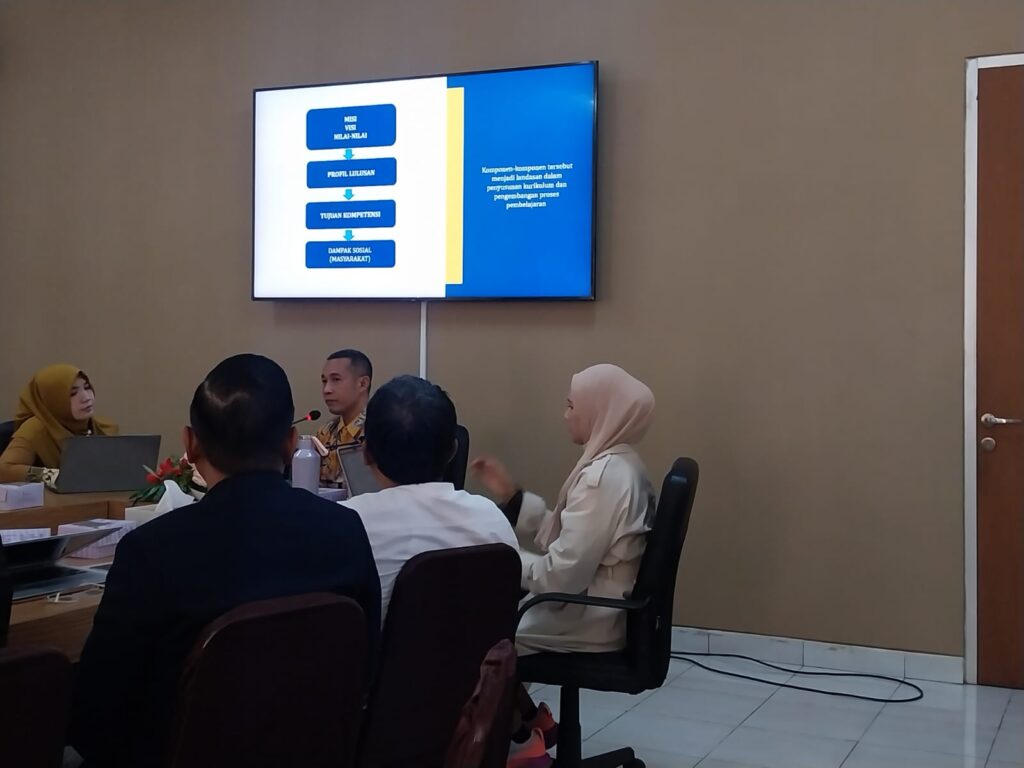
Narasumber Prof. Dr. Mahirun, SE, M.Si, paparkan materi kurikulum berbasis OBE. (Foto: Eka Nurcahyo/Malang Post)
Karena kalau tidak dievaluasi, kita khawatirnya salah memberikan apa yang dibutuhkan mereka dan dunia kerja. Untuk workshop kurikulum kali ini berbasis OBE. Yaitu, kurikulum terakhir yang dinyatakan dalam Peraturan Menteri Sains dan Teknologi (Permendikti Sainstek) No 39/2025.
Itu juga merupakan amanah dari peraturan pemerimtah. Yang kedua, OBE itu juga menjadi syarat untk mendapatkan akreditasi unggul. Yang ketiga, akreditasi Internasional kini mewajibkan kurikulumnya berbasis OBE,” jelasnya.
Sebenarnya kurikulum OBE ini telah dia sosialisasikan dan juga telah dilaksanakan workshop. Namun, OBE yang terbaru itu adalah yang telah sesuai dengan tahapan-tahapan yang diminta oleh lembaga akreditasi lambeda. Ada delapan tahap,” ujarnya.
Terus apa bedanya kurikulum OBE dengan yang sebelumnya. Kalau OBE itu adalah apa yang bisa dibuat mahasiswa. Kemampuan apa yang bisa dilakukan mahasiswa. Kalau kurikulum non OBE itu, apa yang dipelajari mahasiswa.
Terkait apa yang bisa dipelajari mahasiswa, lanjutnya, itu tidak cukup. Harus ditingkatkan ke kemampuan apa yang mereka miliki. “Ini prinsip utama dari OBE. Sehingga OBE-nya itu sudah mengacu kepada salah satunya tadi disampaikan kepada visi misi kampus, stakeholder, dengan dunia kerja.”
“Ini harus kita respons. Mahasiswa bisa apa? Misal begini, ada mata kuliah, CPL (capaian pembelajaran lulusan), mahasiswa mampu menyusun rencana bisnis. Itu mata kuliah apa yang pas untuk kemampuan ini. Terus ini nanti diukur, sejauh mana mahasiswa itu menyusun rencana bisnis, dengan standar ukuran-ukuran evaluasi,” papar Misbahul Munir.
Untuk mencapai itu, menurut Misbshul, tidak hanya mengedepankan skill atau kemampuan. “Di OBE itu ada tiga aspek. Ada aspek pengetahuan, skill atau keterampilan. Dan keterampilan itu ada keterampilan umum, ada keterampilan khusus. Dan yang ketiga ada aspek sikap,” jelasnya.
SementaraProf. DR. Mahirun, S.E., M.SI menyatakan sebenarnya dia merasa minder, sekaligus terhormat bisa berada di UIN Maulana Malik Ibrahim. Minder karena Universitas Pekalongan dirasa masih muda dari UIN Malang dan lebih kecil kampusnya. Terhormat karena bisa bersilaturrahim dengan orang- orang yang profesional di bidangnya di Fakultas Ekonomi UIN Malang.
“Apa yang harus mampu dilakukan oleh lulusan setelah menyelesaikan pendidikan? Inilah pentinya kita mengenalkan OBE sekarang sehingga CPL kita lebih meningkat dan berdampak sekarang ini,” ujarnya.
OBE adalah pendekatan pendidikan yang berfokus pada capaian pembelajaran (learning outcomes) yang harus dimiliki mahasiswa setelah menyelesaikan suatu program studi. Dalam OBE, seluruh proses pendidikan—mulai dari kurikulum, metode pembelajaran, hingga penilaian—dirancang untuk memastikan mahasiswa mencapai kompetensi yang telah ditetapkan.
OBE adalah sistem pendidikan yang menekankan pencapaian kompetensi lulusan secara terukur. Bagi program studi, OBE sangat penting karena menjamin mutu lulusan; Menjadi bukti pencapaian lulusan; Memenuhi tuntutan akreditasi nasional dan internasional; Mendukung budaya perbaikan berkelanjutan, dan meningkatkan daya saing lulusan dan dan institusi. (*/Eka Nurcahyo)